
Buildium vs TurboTenant (2026): Which Property Management Tool Fits Small Landlords?

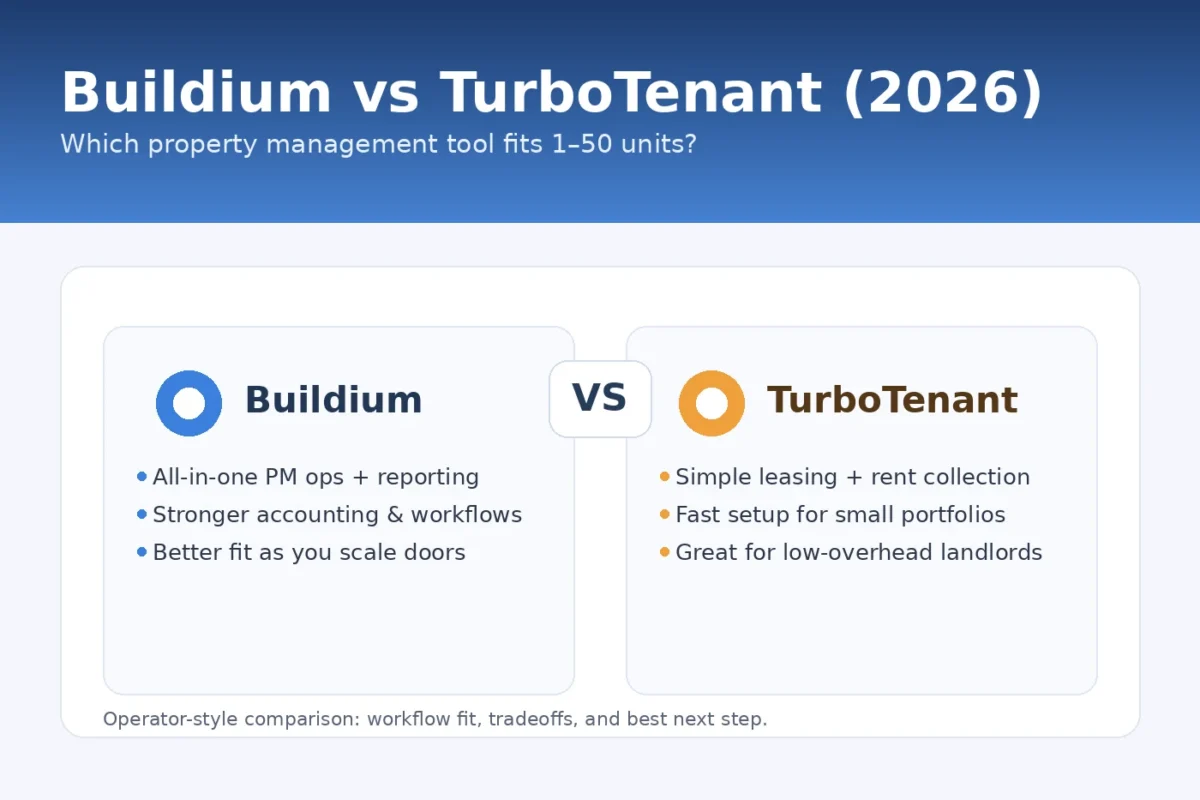
Buildium and TurboTenant both help landlords run rentals — but they’re built for different workflows.
Buildium is usually the better fit when you want a more complete property management system with stronger accounting, reporting, and operations structure as you grow doors.
TurboTenant is usually the better fit when you want fast setup for leasing + rent collection with low overhead, especially for smaller portfolios.
This guide compares Buildium vs TurboTenant like an operator: what each is best for, where they break, and which one you should choose based on your workflow.
Quick verdict
- Pick Buildium if you want a full operations system (stronger accounting + reporting + maintenance workflows) and you plan to grow.
- Pick TurboTenant if you want something simple and landlord-friendly for leasing + rent collection with minimal setup.
Disclosure: Some links on this page are affiliate links, which means we may earn a commission at no extra cost to you. I only recommend tools I’d use to run a rental operation. See our Affiliate Disclosure: /affiliate-disclosure/
Side-by-side comparison: Buildium vs TurboTenant
| Tool | Best for | Why it wins | Watch-outs | Best next step |
|---|---|---|---|---|
| Buildium | All-in-one PM ops + reporting | Stronger accounting + maintenance workflows + reporting as you add doors | More setup; can feel heavy for very small portfolios | Try Buildium |
| TurboTenant | Simple leasing + rent collection | Fast setup for applications + screening + leases + rent with low overhead | May feel limited if you want deep accounting/reporting as you scale | Try TurboTenant |
See: Buildium pricing and plan recommendations
Also: TurboTenant Pricing
What matters most for small landlords
Most small landlords want the same outcomes:
- Faster leasing (less vacancy)
- On-time rent collection
- Clean maintenance tracking
- Easy reporting at tax time
The right tool is the one that reduces missed steps and admin time — not the one with the longest feature list.
Buildium vs TurboTenant: the real difference
Buildium is a system for operations and reporting.
TurboTenant is a lightweight tool for leasing and rent.
- If you’re moving toward 10–50 units and want structure, Buildium usually ages better.
- If you’re under 10 units and want speed, TurboTenant often wins.
1) Leasing workflow (applications, screening, leases)
TurboTenant is typically the faster win here.
Best for:
- Quick applications and screening
- Simple lease templates and signing flow
- Lower-friction setup
Buildium can handle leasing too, but it’s often chosen for what happens after move-in: operations, reporting, and maintenance structure.
Operator take:
If your top pain is filling vacancies and collecting rent with minimal setup, TurboTenant is hard to beat.
If you want everything to connect into a more “professional PM system,” Buildium starts to make more sense.
2) Rent collection and tenant payments
Both handle rent collection, so the question becomes:
- How quickly can you set it up?
- How clean are the records when you need reports?
- Do you want to manage this like a simple landlord, or like a scaled operation?
TurboTenant is usually simpler early.
Buildium tends to be stronger when you want more formal accounting structure and reporting.
3) Maintenance tracking and vendor workflows
This is where landlords feel chaos.
If maintenance is frequent (older homes, multiple units, vendors), you’ll want:
- Work order tracking
- Clear status updates
- History by unit and tenant
Buildium is typically stronger when maintenance workflows matter.
TurboTenant can work fine if maintenance is lighter and you’re okay keeping processes simple.
Operator take:
If you’re dealing with recurring maintenance and vendors, Buildium’s structure is usually worth it.
If maintenance is occasional and you mostly want leasing + rent, TurboTenant is usually enough.
4) Accounting and reporting (the tax time test)
This is where most landlords regret picking the wrong tool.
If you want:
- Cleaner financial reporting
- Fewer spreadsheet headaches
- More visibility across units
- A system you won’t outgrow
…Buildium is usually the safer bet.
TurboTenant is often better for landlords who don’t want heavy setup and are fine keeping accounting/reporting simpler (especially at low unit counts).
Best-by-scenario recommendations
Best if you’re staying small and want low overhead: TurboTenant
Best for all-in-one PM operations + reporting: Buildium
Best for simple leasing + rent collection with low friction: TurboTenant
Best if you’re scaling from 10 units toward 50 units: Buildium
Suggested stacks (what I’d run)
Starter stack (1–10 units)
- TurboTenant for leasing + rent collection → /go/turbotenant
- Simple maintenance process (request → assign → update → close)
- Monthly “admin day” to keep records clean
Growth stack (10–50 units)
- Buildium for scale-ready ops + reporting → /go/buildium
- Maintenance SOP (intake → assign → vendor update → closeout)
- Monthly reporting cadence (owner-style review even if you own it)
Get the Landlord Ops Automation Pack (PDF)
12 automations + templates to run rentals with less chaos.
We won’t send spam. Unsubscribe any time.
FAQs
Which is better for small landlords: Buildium or TurboTenant?
It depends on workflow. TurboTenant is usually better for fast leasing + rent collection with low overhead. Buildium is usually better if you want a more complete operations system with stronger reporting as you grow.
Do I need Buildium if I only have a few units?
Not always. If you’re 1–10 units and your main goal is simple leasing + rent collection, TurboTenant is often enough. If you want structure and reporting because you plan to grow, Buildium can be worth starting earlier.
What’s the biggest mistake landlords make when picking PM software?
Choosing based on features instead of workflow. The best tool is the one you’ll actually use weekly: leasing, rent, maintenance, and records.
Can I switch from TurboTenant to Buildium later?
Yes, but switching is annoying. If you expect meaningful growth in the next 12–18 months, Buildium is often the more future-proof choice.
Related guides (internal links)
- Best property management software for small landlords → /best-property-management-software-small-landlords/
- Buildium review → /buildium-review/
- TurboTenant review → /turbotenant-review/
Table of Contents
Sources
- TurboTenant official site
- Buildium official site