
Buildium vs TurboTenant (2026): Which Property Management Tool Fits Small Landlords?

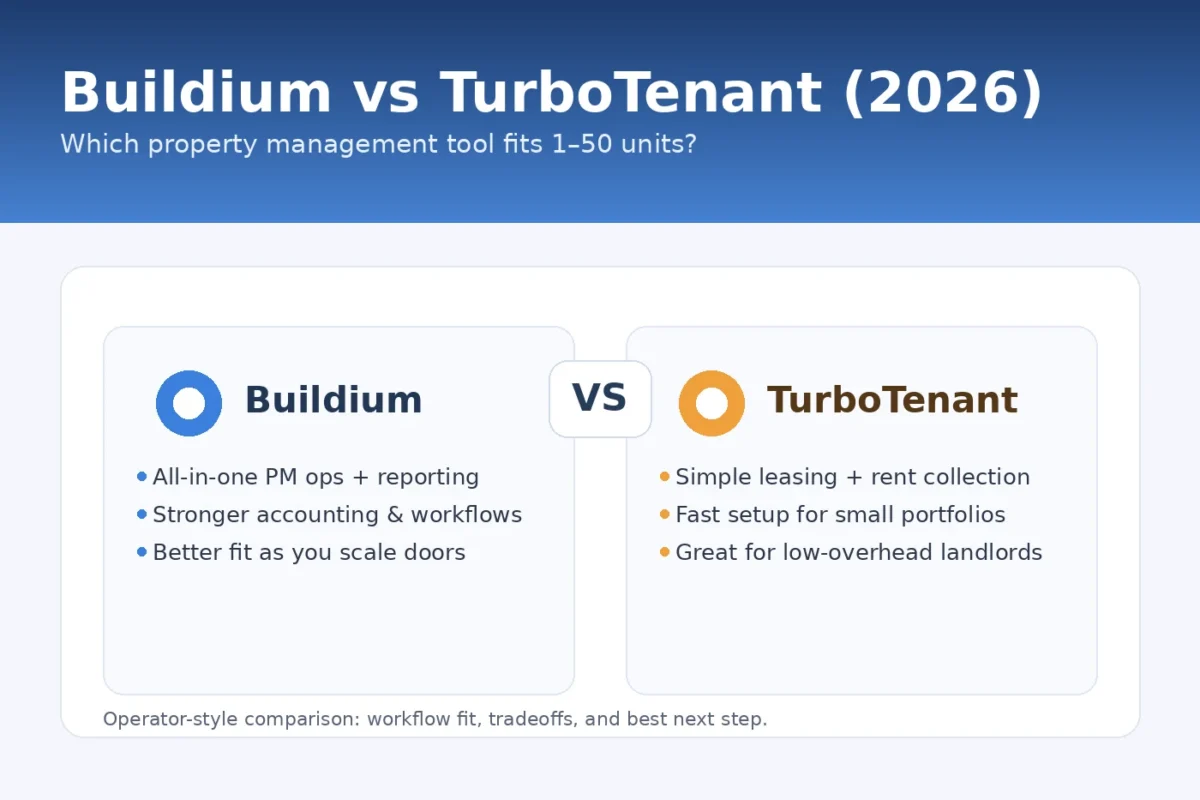
If you are comparing Buildium vs TurboTenant, the real question is not which tool has more features. It is which one fits the way you actually run rentals today, and which one will still fit six to twelve months from now.
For most small landlords, the choice comes down to this:
- TurboTenant is usually the better fit when you want fast setup for leasing and rent collection with minimal overhead.
- Buildium is usually the better fit when you want a more complete property management system with stronger accounting, reporting, and operational structure as you grow.
That is why this guide is focused on workflow fit, not just feature lists.
Below, I’ll break down where each tool wins, where each starts to feel limited, and which one makes more sense based on your portfolio size, management style, and growth plans.
Quick verdict
TurboTenant is usually the better choice for smaller landlords who want simple leasing and rent collection with low setup friction. Buildium is usually the better choice for landlords who want deeper property management operations and stronger reporting as they add doors.
Pick Buildium if:
- you want a more complete property management system
- accounting and reporting matter now
- maintenance workflows are becoming more complex
- you expect to grow and do not want to switch platforms later
Pick TurboTenant if:
- you want the fastest setup
- your main needs are leasing, screening, leases, and rent collection
- you are keeping overhead low on a smaller portfolio
- you do not need deep accounting or operational structure yet
Bottom line: TurboTenant wins for simplicity. Buildium wins for operational depth.
Disclosure: Some links on this page are affiliate links, which means we may earn a commission at no extra cost to you. I only recommend tools I’d use to run a rental operation. See our Affiliate Disclosure: /affiliate-disclosure/
Side-by-side comparison: Buildium vs TurboTenant
| Tool | Best for | Why it wins | Watch-outs | Best next step |
|---|---|---|---|---|
| Buildium | All-in-one PM ops + reporting | Stronger accounting + maintenance workflows + reporting as you add doors | More setup; can feel heavy for very small portfolios | Try Buildium |
| TurboTenant | Simple leasing + rent collection | Fast setup for applications + screening + leases + rent with low overhead | May feel limited if you want deep accounting/reporting as you scale | Try TurboTenant |
See also: Buildium pricing and plan recommendations
Also: TurboTenant Pricing
What matters most for small landlords
Most small landlords are trying to improve the same four outcomes:
- faster leasing and fewer vacancy days
- on-time rent collection
- cleaner maintenance tracking
- easier records and reporting at tax time
That is why the right software is usually the one that reduces missed steps and admin time, not the one with the longest feature list.
A landlord with 3 units and simple operations often needs something very different from a landlord managing 20 or 40 units with vendors, maintenance volume, and more reporting pressure.
Buildium vs TurboTenant: the real difference
The cleanest way to think about it is this:
Buildium is a more complete operations system.
TurboTenant is a lighter leasing-and-rent system.
That distinction matters more than any single feature comparison.
- If you are moving toward 10 to 50 units and want more structure, Buildium usually ages better.
- If you are under 10 units and want speed with low friction, TurboTenant often wins.
So the decision is less about which platform is “better” in the abstract and more about whether you need:
- a simpler landlord tool, or
- a more formal property management system
See our full review of each here: Buildium Review and TurboTenant Review
1) Leasing workflow (applications, screening, leases)
This is usually where TurboTenant has the edge.
TurboTenant wins if you want:
- quick applications and screening
- simple lease templates and e-sign flow
- lower-friction setup
- a tool you can start using quickly
Buildium wins if you want:
- leasing tied more closely into a broader PM system
- more operational consistency after move-in
- one system that better supports scaling processes
Operator take:
If your biggest pain is filling vacancies and collecting rent with minimal setup, TurboTenant is hard to beat. If you want everything to connect into a more structured long-term property management system, Buildium makes more sense.
2) Rent collection and tenant payments
Both tools can handle rent collection, so this section is less about “can they do it?” and more about how you want to run the operation.
Ask:
- how fast do I need this live?
- how clean do I want the records later?
- am I managing this like a simple landlord setup or a more formal operation?
TurboTenant is usually easier earlier.
Buildium tends to make more sense when cleaner financial structure and deeper reporting start to matter more.
If you mainly want to get tenants paying online quickly without much setup, TurboTenant usually has the advantage.
If you are thinking longer-term about reporting, portfolio visibility, and repeatable processes, Buildium tends to be stronger.
3) Maintenance tracking and vendor workflows
This is where many landlords start feeling operational chaos.
If maintenance is becoming a bigger part of the business, you usually want:
- work order tracking
- status updates
- vendor coordination
- history by property, unit, and tenant
That is where Buildium usually has the stronger case.
TurboTenant can still work well if:
- maintenance volume is lighter
- vendors are simple to manage
- you are comfortable with a less formal process
Operator take:
If recurring maintenance and vendor coordination are real pain points, Buildium’s extra structure is often worth it. If maintenance is occasional and your main need is still leasing plus rent collection, TurboTenant is usually enough.
4) Accounting and reporting (the tax time test)
This is one of the biggest separation points in the comparison.
If you want:
- cleaner financial reporting
- fewer spreadsheet headaches
- stronger visibility across units
- a system you are less likely to outgrow
…Buildium is usually the safer choice.
TurboTenant is often the better choice for landlords who want lower setup overhead and are comfortable keeping accounting and reporting simpler, especially at smaller unit counts.
This is also where a lot of landlords end up wishing they had chosen differently from the start.
Best-by-scenario recommendations
Best if you’re staying small and want low overhead: TurboTenant
Choose TurboTenant if your top priorities are:
- simple leasing
- quick onboarding
- rent collection
- minimal setup friction
Best for all-in-one PM operations + reporting: Buildium
Choose Buildium if your business is starting to need:
- cleaner operations
- stronger maintenance structure
- more reliable reporting
- a more scalable system
Best for simple leasing + rent collection with low friction: TurboTenant
If your goal is to fill vacancies, collect rent, and keep things simple, TurboTenant is usually the better fit.
Best if you’re scaling from 10 units toward 50 units: Buildium
If growth is real and you want a system that supports it better over time, Buildium usually wins.
Need More Buildium alternatives? More TurboTenant Alternatives?
When Buildium is the better choice
Buildium usually makes more sense when:
- your portfolio is growing
- maintenance is becoming more operationally heavy
- you care about reporting and accounting structure
- you want one system to support a more professional management process
- you would rather set up more now than switch platforms later
When TurboTenant is the better choice
TurboTenant usually makes more sense when:
- you want to get started fast
- you have a smaller portfolio
- your main pain points are leasing and rent collection
- you want lower overhead
- you do not need deep reporting or a heavy operations layer yet
Biggest mistake landlords make in this decision
The biggest mistake is choosing based on features instead of weekly workflow.
The better question is not:
“Which one can do more?”
The better question is:
“Which one will I actually use consistently for leasing, rent, maintenance, and records?”
The platform that fits your actual habits usually outperforms the platform with the more impressive feature list.
Suggested stacks: what I would run
Starter stack (1–10 units)
- TurboTenant for leasing and rent collection
- simple maintenance process: request → assign → update → close
- one monthly admin day to keep records clean
Growth stack (10–50 units)
- Buildium for scale-ready operations and reporting
- maintenance SOP: intake → assign → vendor update → closeout
- monthly reporting cadence, even if you self-manage everything
Get the Landlord Ops Automation Pack (PDF)
12 automations + templates to run rentals with less chaos.
We won’t send spam. Unsubscribe any time.
FAQs
Which is better for small landlords: Buildium or TurboTenant?
It depends on workflow. TurboTenant is usually better for fast leasing and rent collection with lower overhead. Buildium is usually better if you want a more complete operations system with stronger reporting as you grow.
Do I need Buildium if I only have a few units?
Not always. If you have 1 to 10 units and your main goal is simple leasing and rent collection, TurboTenant is often enough. If you want stronger structure and reporting because you plan to grow, Buildium can be worth adopting earlier.
What’s the biggest mistake landlords make when picking PM software?
Choosing based on features instead of workflow. The best tool is usually the one you will actually use every week for leasing, rent, maintenance, and records.
Can I switch from TurboTenant to Buildium later?
Yes, but switching is usually annoying. If you expect meaningful growth over the next 12 to 18 months, Buildium is often the more future-proof choice.
Final recommendation
Choose TurboTenant if you want the simplest path to leasing and rent collection with low overhead. Choose Buildium if you want deeper operational structure and stronger reporting as your portfolio grows.
For many small landlords:
- TurboTenant is the better starting point
- Buildium is the better long-term operating system
The right answer depends on whether you need simplicity now or more operational depth for the next stage of growth.
Related guides (internal links)
- Best property management software for small landlords
- Buildium review
- TurboTenant review
- Buildium pricing
- TurboTenant pricing
- Buildium alternatives
- TurboTenant alternatives
Table of Contents
Sources
- TurboTenant official site
- Buildium official site