
AI Follow-Up Sequence for Real Estate Investors (2026): The 7/14/30-Day System That Closes Deals

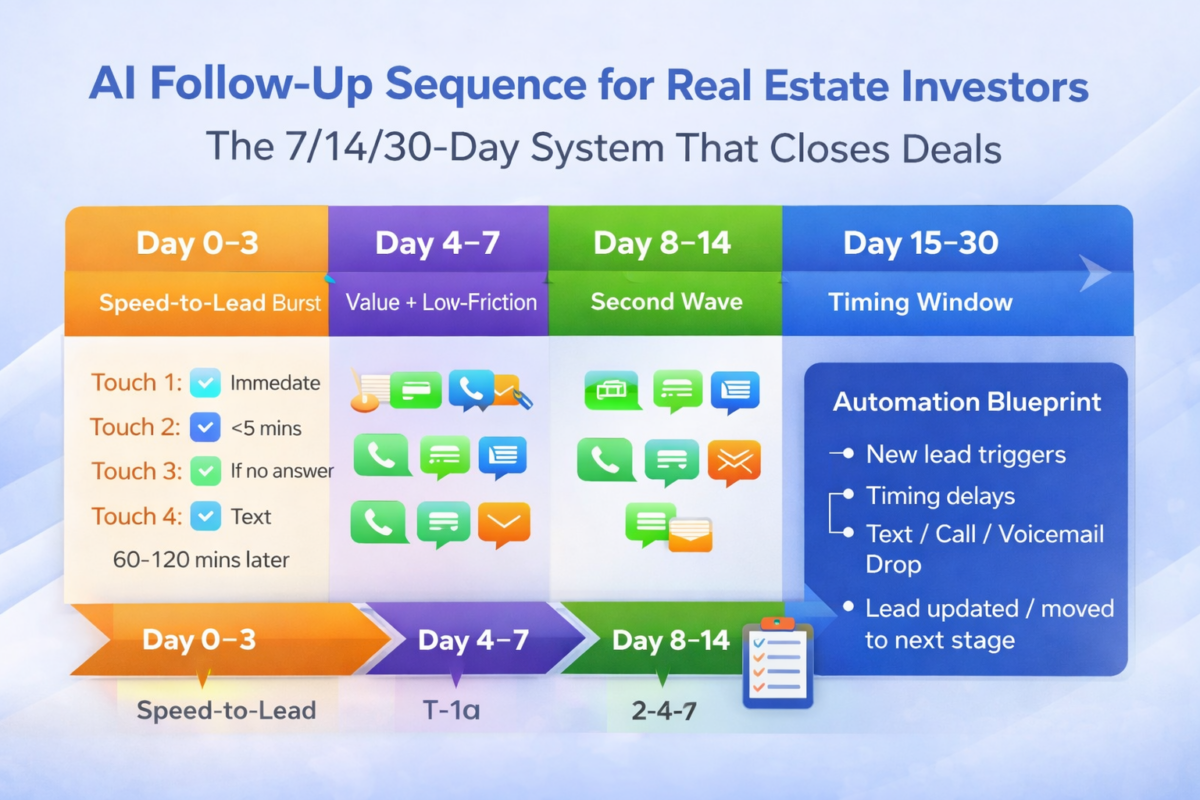
If you want more deals, the lever usually is not more leads. It is speed-to-lead and consistent follow-up.
This is the follow-up sequence most real estate investors need: fast Day 0 contact, consistent attempts through Day 14, and light touches through Day 30.
Most investors lose money in the gap between a new lead coming in (D4D, list pull, referral, inbound) and the first 24–72 hours of outreach plus the next 30 days of touches.
This AI follow-up sequence for real estate investors gives you a simple 7/14/30-day cadence you can run in any CRM, plus copy/paste templates (text, voicemail, email) and a clean automation checklist.
If you are still picking your CRM, start here: Best AI CRM guide
If your leads are coming from D4D, start here: Best Driving for Dollars App (AI)
Quick verdict
- If you want the easiest investor-first execution, use REsimpli and run the 7/14/30 system exactly as written below.
- If you want maximum customization and you do not mind setup complexity, use HubSpot and map the same sequence into workflows and pipelines.
Disclosure: Some links on this page are affiliate links, which means we may earn a commission at no extra cost to you. I only recommend tools I’d use to run an investor deal flow. See our Affiliate Disclosure: /affiliate-disclosure/
Start here (most important setup)
Do these two things first:
- Make sure every new lead triggers Day 0 actions automatically (call + text within 5–15 minutes).
- Assign an owner and a due time for every follow-up task so nothing leaks.
- If you need the CRM setup steps, use this: AI CRM Setup (8 steps)
The follow-up goal (what “good” looks like)
A good follow-up system does 3 things:
- Responds fast (ideally < 5 minutes, definitely < 15 minutes)
- Creates “attempt momentum” (multiple touches early)
- Stays alive for 30+ days without you “remembering” to do it
If your system doesn’t force consistency, it’s not a system — it’s willpower.
The 7/14/30-Day Follow-Up Sequence Blueprint
Use this sequence for:
- inbound motivated seller leads
- D4D leads (door knocks, notes, calls)
- list pull leads (cold outreach)
- referrals
Rule of thumb:
- Day 0–3 is where most deals are won.
- Day 4–14 is where most deals are rescued.
- Day 15–30 is where most deals are created.
Day 0 (first 0–15 minutes): The speed-to-lead burst
- Touch 1 (Text): immediate
- Touch 2 (Call): within 5 minutes
- Touch 3 (Voicemail): if no answer
- Touch 4 (Text): 60–120 minutes later
✅ If you only do one thing: Call + text immediately.
Day 1–3: The “we’re real” cadence
Day 1
- Call (morning)
- Text (afternoon)
Day 2
- Call
- Text
Day 3
- Call
- Optional email (if you have an email)
This is not spam. It’s professional persistence. Sellers respond when timing becomes right — your job is to be the operator who’s still there.
Need the actual talk tracks? Use these AI scripts for motivated seller calls.
Day 4–7: The “value + low-friction” phase
Day 4
- Text: “quick question” / “permission-based” message
Day 5
- Call + voicemail
Day 6
- Text: “I can make this easy” offer
Day 7
- Call (final attempt for week 1)
Day 8–14: The second wave (most investors quit here — don’t)
Day 10
- Text
Day 12
- Call + voicemail
Day 14
- Text (close the loop + easy reply options)
Day 15–30: The long tail (the “timing” window)
Day 18
- Call
Day 21
- Text
Day 24
- Call + voicemail
Day 30
- Text: “last check-in” + relationship-preserving exit
If you run this exactly, you’ll consistently win deals from leads your competitors abandon.
Next step: set your CRM up so the 7/14/30 system runs automatically → AI CRM Setup (8 steps)
The templates (copy/paste)
Template A: Speed-to-lead text (Day 0)
“Hey {{first_name}} — this is {{your_name}}. I saw your info come through about the property at {{address}}. Are you the owner?”
Template B: Missed call text (Day 0)
“Just tried calling — didn’t want to miss you. If it’s easier, you can reply here. Are you open to an offer on {{address}}?”
Template C: Voicemail (Day 0–3)
“Hi {{first_name}}, this is {{your_name}}. I’m calling about {{address}} — I’m interested in making an offer. No pressure. You can call/text me at {{number}}. Again {{number}}.”
Template D: Permission-based text (Day 4–7)
“Quick question — should I keep reaching out about {{address}}, or is now not a good time?”
Template E: Low-friction offer text (Day 6–14)
“If selling is something you’d consider, I can make this simple: as-is, no repairs, and we pick a closing date that works for you. Want me to put together a quick offer?”
Template F: “Timing” text (Day 15–30)
“Hey {{first_name}} — circling back. If your plans change and selling becomes a priority, I can help. Want me to leave you alone for now, or check in next month?”
The rules that make this work (so it doesn’t feel random)
Rule 1: Always ask a binary question
Examples:
- “Are you the owner?”
- “Open to an offer?”
- “Should I keep checking in or pause?”
Binary questions get replies.
Rule 2: Keep texts short
Long texts look like marketing. Short texts look like a real human.
Rule 3: Log outcomes (or you’ll repeat mistakes)
Every lead should end up in one of these buckets:
- Interested now
- Interested later
- Not interested
- Wrong number / not owner
- Do not contact
That’s why an investor-first CRM matters.
How to automate this in REsimpli (simple version)
If you want to run this with minimal friction:
Step 1: Create 3 statuses
- New Lead (Day 0)
- Active Follow-Up (Day 1–14)
- Long Tail (Day 15–30)
Step 2: Create task templates
- “Call + text now”
- “Call attempt”
- “Text follow-up”
- “Voicemail drop”
Step 3: Assign owners + due dates automatically
The #1 reason follow-up dies is “someone thought someone else had it.”
If you want the deep review first: REsimpli Review
How to run this in HubSpot (if you want customization)
HubSpot can run this well if you set it up correctly:
- Pipeline stages (New → Contacted → Qualified → Offer → Under Contract)
- Workflows triggered by “New lead created”
- Tasks auto-created for call/text attempts
- Optional segmentation by source (D4D vs list pull vs inbound)
Related page: HubSpot for Real Estate Investors
Common mistakes that kill follow-up (and revenue)
Mistake 1: Waiting “until later today”
Speed-to-lead is a compounding advantage. If you’re slow, you’re fighting uphill.
Mistake 2: Only texting (or only calling)
The combo is what works. Call establishes seriousness. Text gets replies.
Mistake 3: No “long tail”
A lot of motivated seller situations are timing-based. Your competitors stop. You don’t.
How this ties into your lead sources
This follow-up system is your conversion engine no matter how you generate leads.
If you want the lead source tools this sequence is built for, start here:
FAQs
What’s the best follow-up sequence for motivated seller leads?
A simple 7/14/30-day sequence that hits fast early (Day 0–3), stays consistent through Day 14, and continues light touches through Day 30.
How many follow-ups does it take to close a deal?
It varies, but most investors under-follow-up. The winning edge is consistency over 30+ days, not a single perfect script.
Should I text or call first?
Do both. Text immediately, call within 5–15 minutes. If no answer, leave a voicemail and send a short “missed you” text.
What CRM is best for real estate investor follow-up?
REsimpli is easiest for investor workflows and small teams. HubSpot is powerful if you want deep customization and don’t mind setup.
Can I use this for cold list outreach too?
Yes — but expect more “not interested” responses. The same cadence works; just keep messages short and permission-based.
Next step (what to do today)
- Copy the 7/14/30 sequence into your CRM as tasks or workflows
- Add the templates as snippets (text, voicemail, email)
- Make sure every new lead triggers Day 0 actions automatically
- Assign every lead an owner and a due time
Need the setup checklist? AI CRM Setup (8 steps)
Table of Contents
Sources: